
Pathways Toward Responsible Marine Carbon Dioxide Removal at Utrecht University
SeaO₂ recently took part in Utrecht University’s Sustainable Ocean Community symposium, Pathways Toward Responsible Marine Carbon Dioxide Removal, which brought together researchers, policymakers, innovators, and industry leaders to explore how marine carbon dioxide removal (mCDR) can develop responsibly in the decades ahead. Set against a backdrop of growing interest in ocean-based carbon removal, as well as increasing public concern, the event highlighted both the promise and the complexity of mCDR as part of broader climate action.
The symposium opened with remarks from Dr. Cale Miller, lead of the seed project on pathways toward responsible mCDR, who emphasized that public attitudes toward mCDR are unclear. He underlined the need for independent verification, impact assessment, and strong collaboration between academia and industry. His introduction framed the discussion around how socially embedded and environmentally sound mCDR pathways could be developed by 2050.
A central theme of the symposium was the co-production of knowledge, highlighted by Dr. Miranda Boettcher of Utrecht University and SWP Berlin. She explained why traditional linear models, in which science simply generates evidence for policymakers, are not sufficient for a field as uncertain and value-laden as mCDR. Instead, she advocated for participatory and transdisciplinary approaches that make assumptions explicit, broaden the range of options considered, and strengthen societal legitimacy. Drawing on examples from the CDRmare programme, she showed how co-designed assessment frameworks and participatory foresight can help navigate key questions around feasibility, desirability, and governance.
From the policy perspective, Martijn van de Sande of RVO presented the forthcoming Innovation Programme Carbon Removal (IPKV), part of the Dutch government’s growing support for carbon removal through the national climate fund. The programme will support research and development, early-stage pilots, and the enabling conditions needed for responsible scaling, including monitoring, reporting and verification (MRV), environmental assessment, and social embeddedness. His presentation underscored the importance of building a strong national innovation ecosystem around CDR.
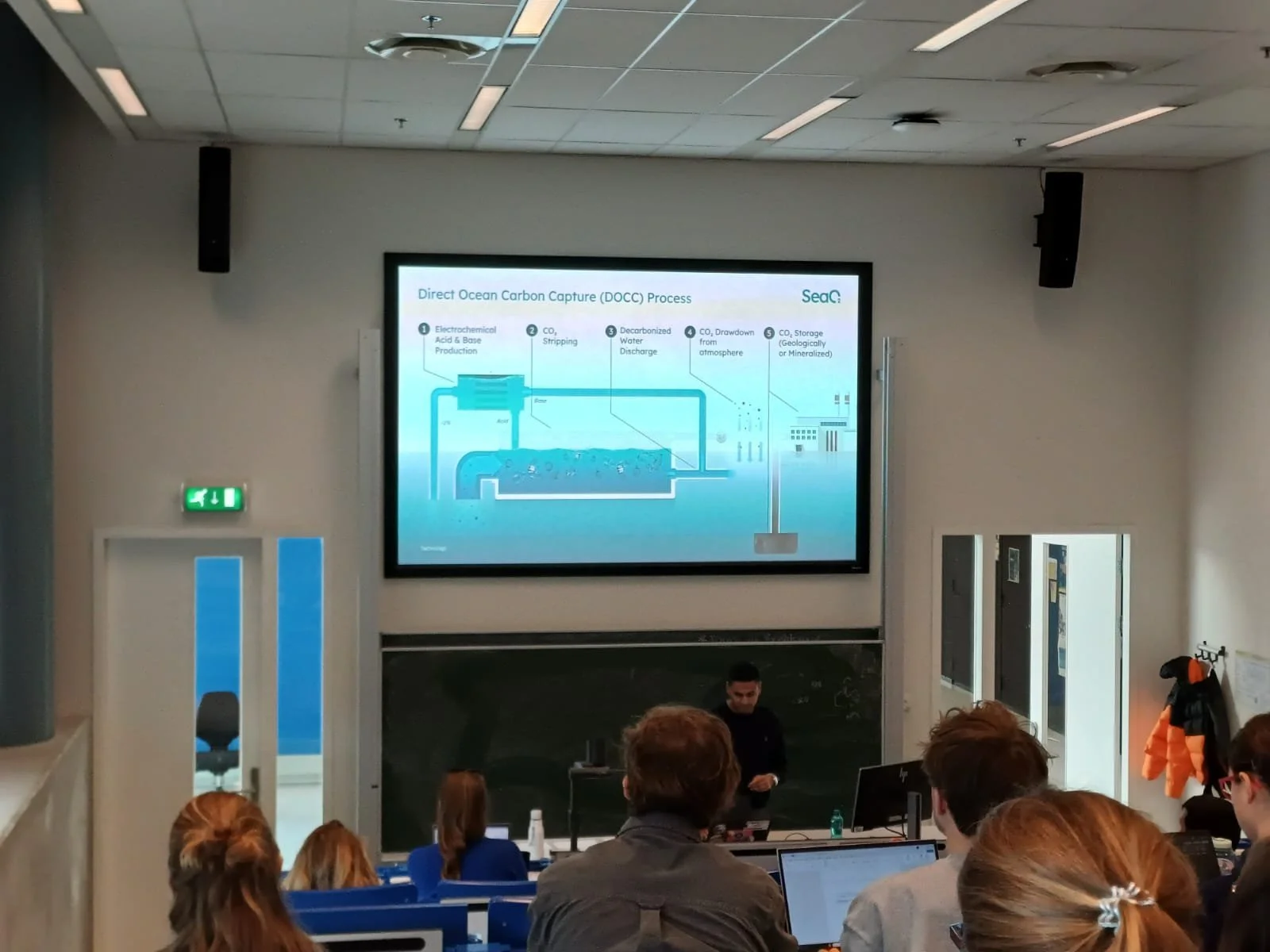
On stage, Zamin Syed shares insights from a collaborative SeaO₂ and University of Twente study, highlighting public awareness and perceptions of marine carbon removal.
SeaO₂ contributed to the symposium through Zamin Syed, Founders Associate at SeaO₂, who shared insights from a small public perception study. The findings showed both a high level of concern about climate change and a very low level of familiarity with marine carbon dioxide removal. This gap highlighted the importance of transparent communication and sustained community engagement, fully in line with SeaO₂’s commitment to responsible deployment. Participants also discussed the widespread confusion in public and media discourse around terms such as carbon dioxide removal (CDR), carbon capture & storage (CCS), and geo-engineering, pointing to the need for clearer communication tools for journalists, policymakers, and local communities.
For SeaO₂, the symposium reinforced a core principle: responsible marine carbon removal must be developed with deep respect for ocean health. Scaling mCDR is not only a technical challenge, but also a societal and environmental one. It requires navigating scientific uncertainty, regulatory gaps, and public values with care and transparency. The discussions made clear that co-production, robust MRV, thoughtful communication, and strong policy design will all be essential to building a credible pathway forward for marine carbon dioxide removal.
